What other POS systems charge
- Software, per location$99–$140/mo
- Card processing2.6–3.8% + ¢
- Premium tiers & add-onsextra
- Proprietary hardwarebuy or lease
- Contractusually
Before you sell a thing$1,188–$1,680/yr
2.79% flat when you take a card — or we match the rate you already pay. Either way, the POS is completely free. A full register for any retailer — from a single cart to a chain of stores.
VoVi is in private beta with US stores. Leave your details and we'll set your shop up with you — products, staff, locations — on one call.
We'll call you as onboarding opens up. Talk soon.
Negotiated prices, fast lines, commissioned sellers, stock in more than one place — one register that fits a cart, a shop or thirty stores.


Most systems charge $99–$140 a month per location before you sell a thing. VoVi is $0.
What other POS systems charge
Before you sell a thing$1,188–$1,680/yr
What VoVi charges
Before you sell a thing$0/yr
Their rate starts where ours sits and climbs. Then the software bill lands on top — $4,680 a year across three locations.
Monthly software fees as published by common retail POS providers; processing rates vary by provider, card type and mix — the upper end reflects keyed, card-not-present and premium rewards cards — so treat the range as typical rather than a quote. VoVi's 2.79% is card-present, flat, interchange included.
Same software behind both — every feature, every location, no tier to climb. The only question is who processes your cards — and if you already pay less than 2.79%, we match it.
Process with VoVi
$0/mo
+ 2.79% flat on Visa, Mastercard & Discover — or we match your rate
* American Express 3.5%
Already on a lower rate? Send a recent statement and we'll match it.
Keep your own processor
$99/mo
per location — and we take no cut at all
Put your own numbers in. This counts software fees only — the part we delete.
3 locations
Comparing POS software fees only, using the numbers you enter above.
$390
back in your pocket / month
$4,680
every single year
That's real inventory, a competition prize pool, or just… profit.
Too big for a slider.
At 20+ locations we'd rather run your real numbers with you than guess at them here.
Okay — figure of speech. But at your size this isn't a slider anymore, it's a phone call.
*Our math team says "a seriously large number". Legal made us say this.
Big fleets jump the line. Talk soon.
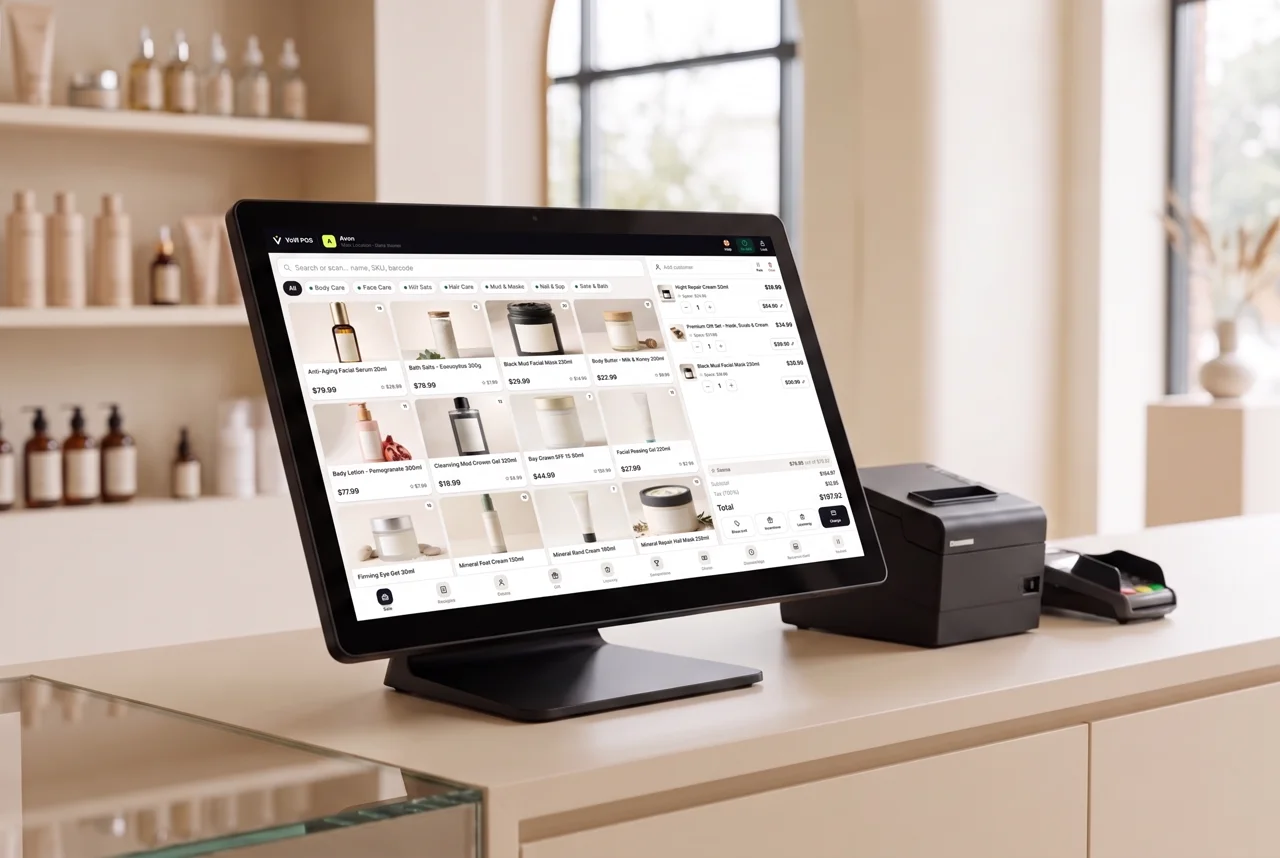
No proprietary terminals, no hardware leases. VoVi runs in the browser on the devices you already own, installs to the home screen like an app, and keeps selling smoothly through a busy Saturday. Selling from a mall cart or kiosk? Here's how VoVi fits a small footprint.
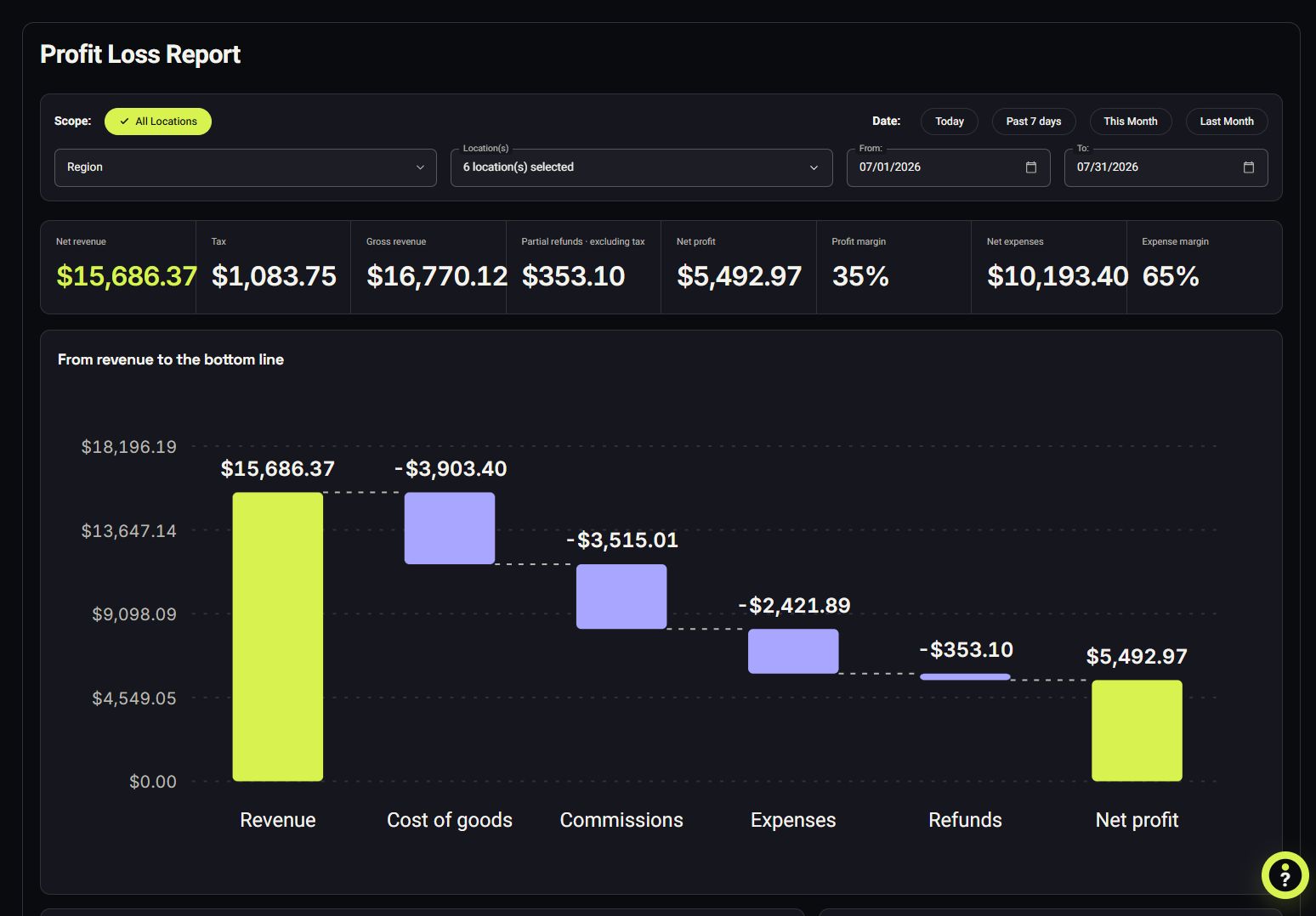
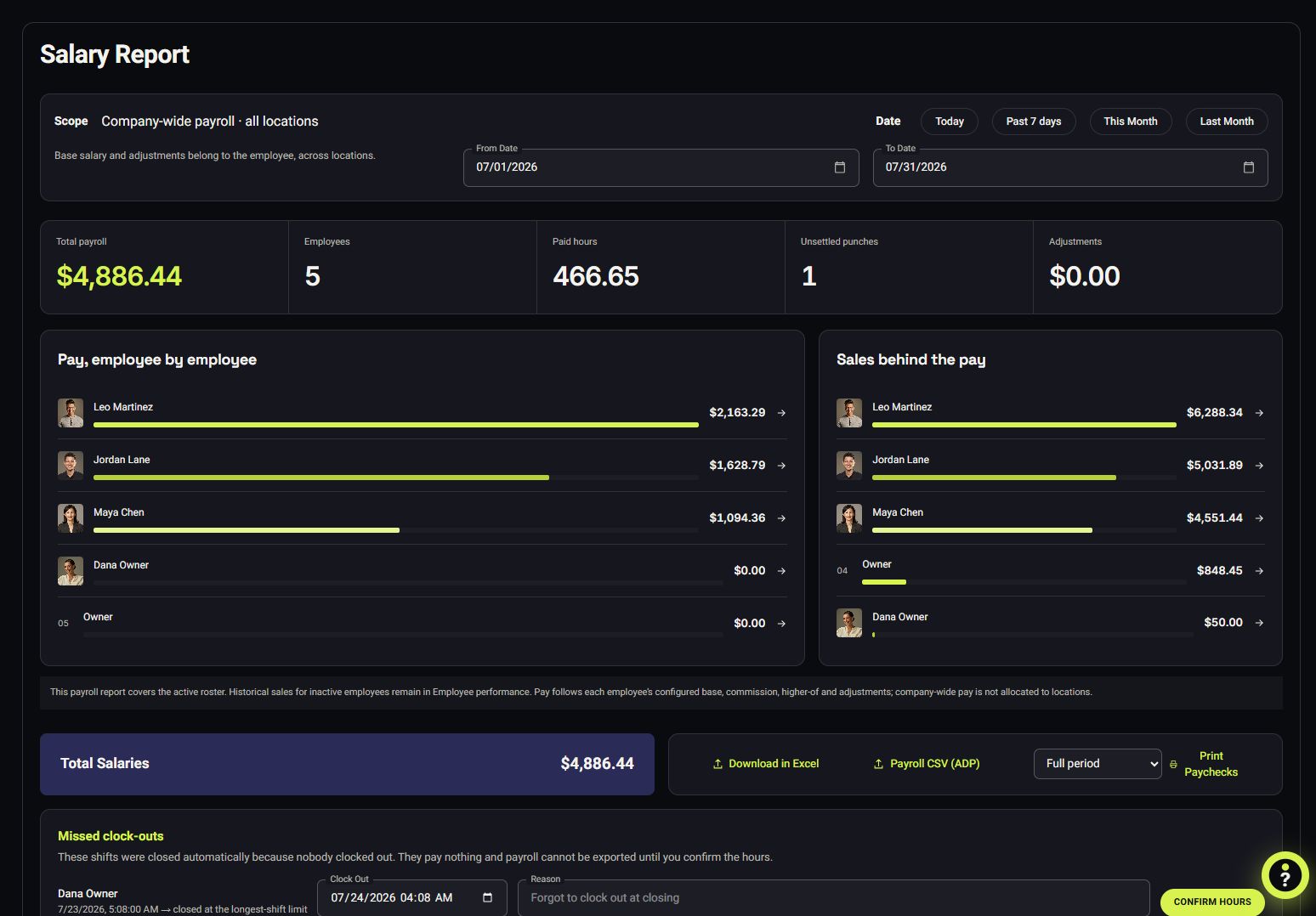
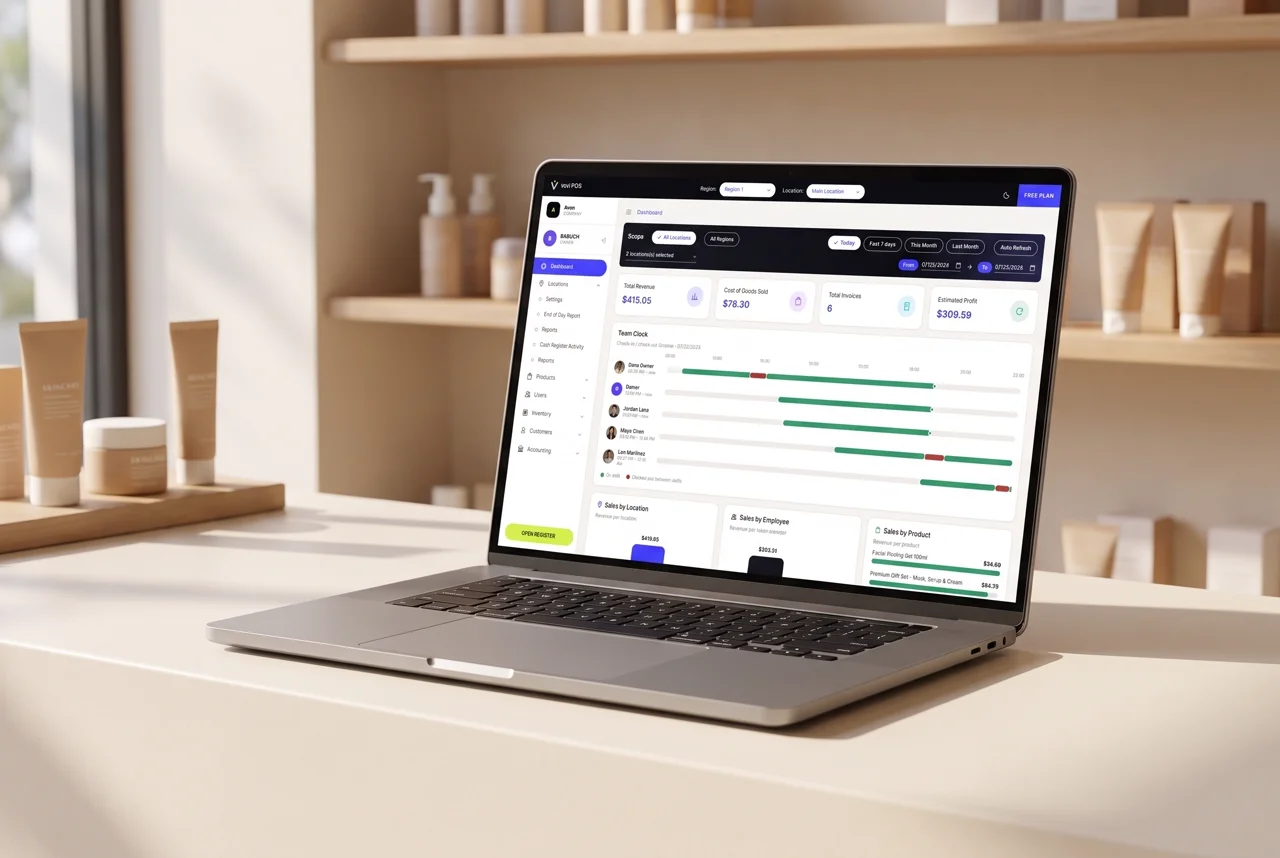
A fast register for whoever is on the floor, and a back office that answers to you. These are real screens from a live store, not mockups.
Owner dashboard — sales, profit, locations, team
Countertop register — checkout in seconds
Sell from your pocket
That's the real software. Dashboard, register and phone — captured from a live VoVi store.
There's one version of VoVi and every store gets all of it — no locked tier, no "contact sales", nothing held back to sell you later. Tap More on anything you want the detail on.
Every unit is a ledger entry, per location. Sold, counted, moved or written off — it balances.
Most retail inventory software gives you a number and asks you to trust it. VoVi gives you the trail behind the number: every sale, count, transfer, tester and loss is a dated line with the staff member's name on it. When the shelf and the screen disagree, you find out which one moved and when.
Minimums and maximums are set per product, per location, so the mall cart carries three and the flagship carries thirty. Daily counts take barcode scans, not a clipboard. Stock moves between stores in one step, or as a two-step shipment that sits in transit until the receiving store counts it in — so "it must be at the other shop" stops being an answer.
Unlike a traditional POS, none of this sits behind a Pro tier. No per-SKU cap, and no charge for a second stockroom.
Revenue, margin, best sellers and who sold them — live, from any phone, any location.
The dashboard opens on the four numbers that decide your week — revenue, cost of goods, invoices and estimated profit — then lets you cut them by location, region, seller, product or date without exporting anything. Every figure drills to the receipts underneath it.
End-of-day ties the drawer to the sales. Profit and loss, expenses, refunds, voids and cash over/short live in the same place, so the story your accountant gets is the story that happened. Export any of it to CSV or Excel — your data is yours, always.
Unlike a traditional POS, real-time multi-location reporting isn't an analytics upsell. Same $0 plan.
Describe the report you want in plain words. VoVi builds it from your own numbers.
Open AI Report Studio from the back office and ask for what you actually want to know — "top twenty products by margin, per location, this month, with a trend line" — and it comes back as stat tiles, charts and sortable tables built from live data. Refine it in conversation, then save it: a saved report runs forever with fresh numbers, at no cost.
It obeys the same permissions as every other screen. A manager who is not allowed to see profit does not get a cost column by asking nicely — the report simply never contains one.
Unlike a traditional POS, a custom report is not a BI add-on, a consultant or an export to a spreadsheet. AI-built and edited reports are pooled at three a day per location; running a saved one is unlimited.
VoVi already knows what dropped below its minimum. It drafts the order; you send it.
Because every product carries a min and max per location, the shortfall is arithmetic rather than a guess. VoVi totals what's missing across the stores you pick, groups it by vendor and hands you a purchase order to review.
Receive against it and the stock lands on the right shelves at the right cost — so margin stays honest instead of drifting with whatever you paid last time. Partial deliveries are normal: receive what turned up, and the rest stays open on the order.
Unlike a traditional POS, low-stock alerts reach your phone the moment a count crosses the line, not in a weekly digest you read on Monday.
Profiles, purchase history and loyalty points that build at the register, automatically.
Attach a customer to a sale in one tap and their history follows them: what they bought, what they returned, what they're still paying off, what store credit they hold. The seller sees it before the conversation starts — the difference between "can I help you" and "the serum you bought in March, ready for another?".
Loyalty runs on the same records. Points accrue per dollar as sales complete and redeem straight against a future basket; you set the earn rate and what a point is worth. No separate app for your customer to install, no second subscription for you.
Unlike a traditional POS, the CRM and the loyalty program aren't two more line items on the invoice. They're in the box.
Card, cash, check, gift card, store credit, split tender, layaway. All standard.
Sell and redeem gift cards, issue store credit instead of a refund, split one basket across two tenders, or hold an item on layaway with a deposit and collect the rest later — with the balance tracked against the customer, not a note under the till.
Cash is handled like money that goes missing: opening float, pay-ins, pay-outs, blind counts and an over/short figure per shift that ties to the end-of-day report.
Unlike a traditional POS, cash, check, gift card and store-credit sales cost you nothing at all — we only earn when a card is involved, at a flat 2.79% on Visa, Mastercard and Discover (American Express 3.5%).
The catalog lives on the register, so a dead connection doesn't close the store.
Mall wifi fails, and it always fails on the busiest afternoon. VoVi keeps your products, prices and categories on the device itself, so search and barcode scanning stay instant with the connection down — and the register says plainly that it's offline instead of spinning at a queue of customers.
We're honest about the boundary: the offline register is rolling out in stages, and card payments always need a connection because the bank does. Everything already shipped is live on your account the day it lands, at no extra cost.
Unlike a traditional POS, you don't buy a "hybrid" tier to get this.
Set a contest in the back office; every register shows the live standings and the prize.
Pick the goal and the prize, and the leaderboard updates from real sales as they ring — every seller sees where they stand without anybody keeping score on a whiteboard. Sales are attributed to the person who made them, so the standings are the same numbers commission and payroll use.
Unlike a traditional POS, this is not a gamification add-on with its own login. It is the register, showing your people the race they are already in.
Every sale is attributed to who sold it. Commission computes as you ring; payroll reads the same numbers.
Splits between two sellers, stepped rates that climb as the day goes, retro bonuses when a threshold is crossed, and the spare — negotiation room — a seller can spend or keep. All of it is computed on the receipt itself, so a commission figure always points back to the sale that earned it.
Payroll exports read those same receipts. There is no Sunday-night spreadsheet, and no argument at month end about who sold what. How commission tracking works in VoVi.
Low stock, a big discount, a drawer that comes up short — you hear about it as it happens, not at month end.
Choose what matters in the back office and it arrives as a notification instead of a line in a report you would have read next week. Loss-prevention exceptions — an unusual drawer variance, discounting that stands out against the team — surface the same way, with the receipt behind them one tap away, so you can act rather than just read.
Unlike a traditional POS, alerts are not a premium tier. They are the register telling its owner what it noticed.
Clock in at the register, see who's on the floor, and pay from the same hours.
Staff clock in and out on the register itself with their own credentials — no separate terminal, no app to install, no paper sheet to lose. The back office shows a live who's at work and a timeline of the day, so "was Jordan actually in at ten?" is a glance, not an argument.
Those hours are the same hours the salary report pays from, sitting next to each seller's sales and accrued commission. One number, one source — instead of a rota in one place, a timesheet in another and commission worked out on a Sunday night.
Unlike a traditional POS, time tracking and commission aren't a workforce add-on with its own monthly fee. They're part of the free plan.
Split a basket into instalments at the counter. In build — layaway does the job today.
Straight answer: BNPL is not live yet. We won't show you a screenshot of something we haven't built. It's in development, and like every other feature on this page it will land on the free plan at no extra cost — no tier, no activation fee.
What ships today is layaway, which solves the same problem from the other end: the customer pays a deposit, you hold the goods, the balance is tracked against their record and collected over as many payments as it takes. Their history, store credit and loyalty points all sit on the same customer, so the balance is never a note under the till.
The difference is who holds the item while it's being paid off. When BNPL lands, that choice becomes yours.
No implementation project. No consultant. No six-week onboarding you pay for twice.
Leave your name and number above. We set up your company, your locations and your team on a call — you never sit alone in a settings screen.
Type products in or import a CSV. Set retail, minimum and spare — and from that moment your margin is protected on every negotiation.
Any tablet or phone becomes a till. Visa, Mastercard & Discover at 2.79% flat, American Express 3.5%, cash for nothing, and the dashboard moving before you have left the parking lot.
Join the beta list — it takes 20 seconds, and it could save you thousands a year.
Get early access